

Sales is the lifeblood of any business. Whether you’re selling a product, service, or an idea, mastering the art of sales is needed for success because without sales your small business will eventually die. In this blog post, we’ll explore the fundamentals of sales, learn about effective selling methods, and provide tips on building a powerful sales flywheel to boost your small business.
At its core, sales is about solving a problem or fulfilling a need for your customer. It’s not just about pushing a product, but about creating value and building trust. Successful salespeople understand their customers’ pain points and tailor their approach to address those specific needs. Building trust and rapport with potential clients is key to converting leads into sales. By understanding the basics of sales techniques such as active listening, objection handling, and closing strategies, entrepreneurs can enhance their sales performance and drive business growth.
To succeed in sales, it’s essential to have a variety of selling techniques in your toolkit. Different customers and situations may require different approaches, so understanding and mastering multiple selling methods will make you more adaptable and increase your chances of closing a sale. Let’s go over some key selling methods you could use when marketing your small business:
Key Selling Methods
- Consultative Selling
What It Is: Consultative selling focuses on creating value by understanding the customer’s needs and providing tailored solutions.
Why It Works: Customers are more likely to buy when they feel understood and when a product or service is directly relevant to their needs. By taking the time to listen and customize your offering, you build trust and position yourself as a partner rather than just a vendor.
How to Do It: Begin by asking open-ended questions to uncover the customer’s pain points. Listen actively, and then propose a solution that directly addresses their concerns.
2. Solution Selling
What It Is: Similar to consultative selling, solution selling involves identifying the customer’s problem and offering your product or service as the solution.
Why It Works: This method shifts the focus from the product’s features to its benefits, making the sale about what the customer will gain rather than what they’ll spend. It’s particularly effective when selling complex products or services where the value isn’t immediately obvious.
How to Do It: Instead of focusing on the features of your product, emphasize the benefits and how they can solve the customer’s specific problem.
3. Relationship Selling
What It Is: This method is all about building and nurturing long-term relationships with customers.
Why It Works: People buy from those they trust. By prioritizing the relationship over the sale, you foster loyalty and increase the likelihood of repeat business. Long-term relationships also open the door to referrals and recommendations, expanding your customer base.
How to Do It: Prioritize trust and rapport over immediate sales. Follow up regularly, provide ongoing support, and stay in touch even after the sale.
4. Value-Based Selling
What It Is: Value-based selling emphasizes the value a product or service can deliver to the customer, rather than the price.
Why It Works: When customers perceive high value, price becomes less of an obstacle. This method is particularly effective in competitive markets where differentiation is key.
How to Do It: Clearly articulate the benefits and ROI (Return on Investment) your product offers. Focus on how it can improve the customer’s life or business.
5. Inbound Selling
What It Is: Inbound selling aligns your sales process with the buyer’s journey, providing value and guidance as they move from awareness to decision.
Why It Works: Today’s buyers are more informed and empowered than ever before. Inbound selling meets them where they are, providing the information and support they need to make a purchase decision at their own pace.
How to Do It: Use content marketing, social media, and SEO to attract potential customers. Engage with them through personalized emails, webinars, and other resources that educate and move them closer to a purchase.
Tips for a Successful Sales
Know Your Audience: The better you understand your target market, the more effectively you can tailor your sales approach. Create detailed buyer personas and use them to guide your sales strategies.
Build Rapport: People buy from people they trust. Take the time to build relationships with your prospects. Listen more than you speak, and show genuine interest in solving their problems.
Handle Objections with Confidence: Objections are a natural part of the sales process. Prepare for common objections and have responses ready. Address concerns with confidence and reassurance.
Follow Up: Many sales are lost due to a lack of follow-up. Stay in touch with prospects, answer their questions, and guide them through the decision-making process.
The Role of a Flywheel in Your Sales Strategy
“The flywheel is a model adapted by HubSpot to explain the momentum you gain when you align your entire organization around delivering a remarkable customer experience. It’s remarkable at storing and releasing energy — and it turns out that’s pretty important when thinking about your business strategy. Invented by James Watt, the flywheel is simply a wheel that’s incredibly energy-efficient. The amount of energy it stores depends on how fast it spins, the amount of friction it encounters, and its size. Think of it like the wheels on a train or a car.” –HubSpot
No matter what sales method (or combination of methods) you choose to employ, a flywheel sales strategy is a great method to use for creating continuous momentum in your business. Unlike a traditional sales funnel, which focuses on guiding prospects through a linear path, a flywheel leverages the energy of satisfied customers to generate more leads, repeat business, and referrals. The flywheel represents a cyclical process where customer acquisition, retention, and advocacy all feed into each other, creating a self-sustaining loop of growth. By focusing on delighting customers at every stage of their journey, you can maximize efficiency, reduce costs, and build a stronger, more resilient business.
The flywheel model consists of three main stages: Attract, Engage, and Delight.
Stages of a Flywheel
Attract
- Goal: Draw potential customers to your brand by offering valuable content and experiences that address their needs.
- Tips: Use content marketing, social media, and SEO to drive traffic to your website. Create educational blog posts, videos, and infographics that answer your audience’s questions and solve their problems.
Engage
- Goal: Build meaningful relationships with prospects by offering solutions tailored to their specific needs.
- Tips: Offer lead magnets like free eBooks, webinars, or templates in exchange for contact information. Use email marketing to stay in touch and provide personalized content that nurtures trust and moves them toward a purchase.
Delight
- Goal: Ensure that your customers are not just satisfied but delighted with their experience, turning them into promoters of your brand.
- Tips: Provide exceptional customer service, offer loyalty programs, and actively seek feedback to continuously improve your offerings. Engaged customers are more likely to become repeat buyers and refer others to your business.
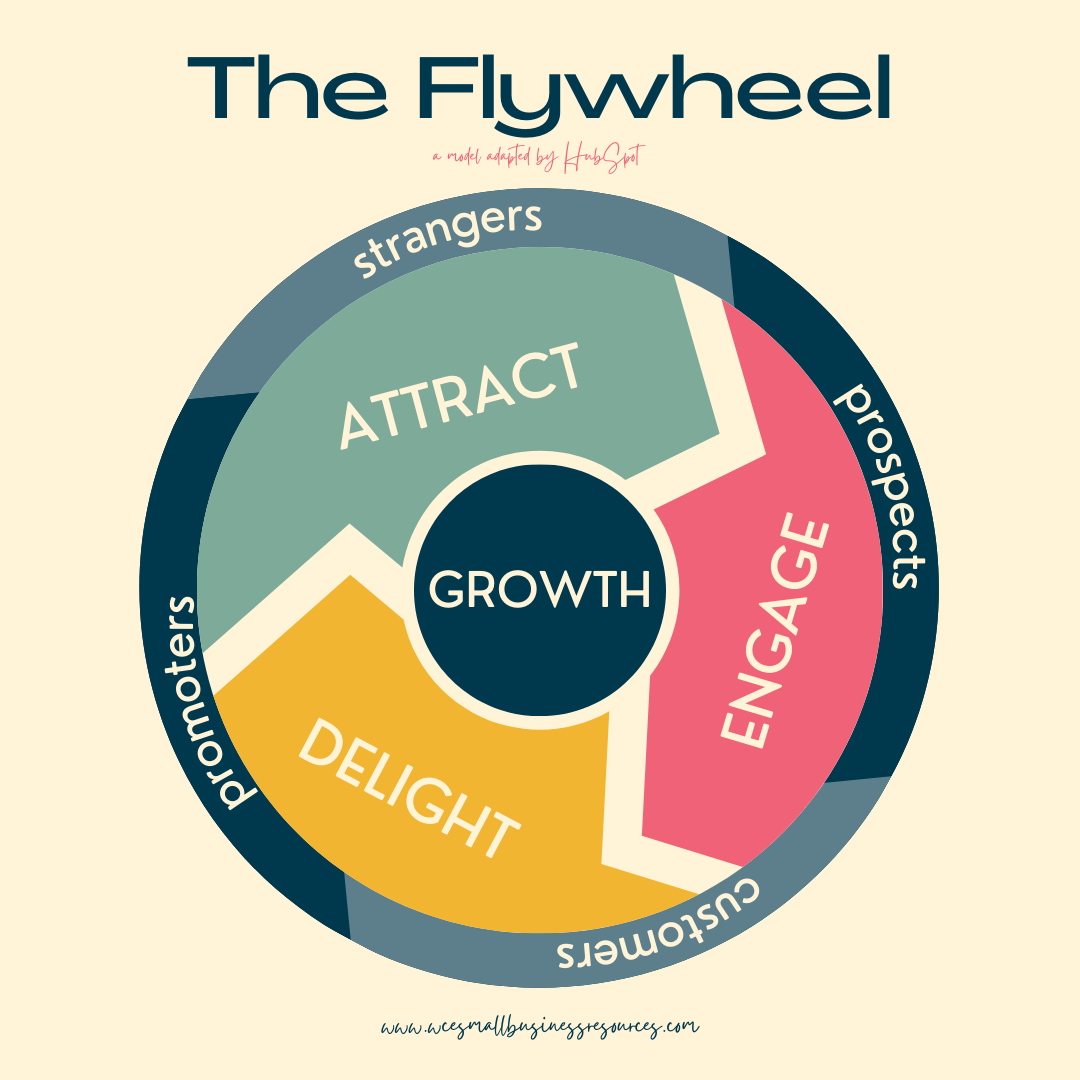
The flywheel will move a person through the stages of being stranger, to a prospect, then moving the right ones to customers, and and then hopefully to promoter. It all begins with attracting strangers through targeted marketing efforts, such as content marketing, social media, and SEO, to draw them into your business and into your flywheel. Once a stranger expresses interest, they become a prospect, and this is where the sales process kicks in! At this stage, your focus is on qualifying the lead, understanding their pain points, and building trust. Effective sales techniques, such as personalized pitches and consultative selling, are crucial to converting prospects into customers. After a sale is made, the relationship doesn’t end. To turn a customer into a promoter, you must ensure they receive exceptional value and a positive experience with your product or service. Following up with them, offering ongoing support, and encouraging testimonials or referrals are key actions that transform satisfied customers into enthusiastic promoters who actively drive new business your way, creating a self-sustaining sales engine. Make sure to regularly review your flywheel strategy and process. Identify bottlenecks and areas for improvement. Use any data you have collected to make informed decisions and optimize your approach.
Mastering sales takes time, patience, and practice. By understanding your customer’s needs, utilizing effective selling methods, and building a strong flywheel sales strategy, you can significantly improve your conversion rates and drive sustainable business growth. Remember, the goal is not just to close a sale, but to create lasting value for your customers and build long-term relationships. With a solid grasp of these selling methods and the flywheel strategy, you can turn satisfied customers into your greatest sales asset, fueling continuous growth and success in the competitive world of sales.
If you found this helpful you can discover more tips, free downloads and articles HERE. You can also become a member of WCE and get access to all of our downloads and resources instantly with free networking & mastermind events! Learn more by clicking the button below:
And please check out WCE’s On-Demand Education! We have topics covering all aspects of running a business. You can find them HERE!
If you are not a subscriber to WCE’s newsletter you need to ASAP! Our newsletters are filled with inspiration, resources, and free downloads that go straight to your inbox every week! Click the button below for more info.

 WCE Small Business Resources